If we share a common humanity what matters in terms of how language is used is not what we think is affirming or hurtful BUT how those being addressed, or described, receive what is being said.
If I feel affirmed or put down by how I am named or described that is real for me, however the person addressing me feels about what they are saying.
Empathy and listening is needed before we condemn changes in language that we might see as ‘fashionable’ or unnecessary.
All of this ought to apply to our day to day conversation as we recognise the common humanity we share with one another, whatever name, creed, gender, orientation, self-identification or other criteria.
It is equally important in public documents and conversation, politically, in religious worship and in every other sphere
UK Methodism – taking stock… Andrew Pratt (10/8/2025)
The words of Ecclesiastes remind us that… ‘To everything there is a season’. Life goes on, season to season, year to year.
John Wesley referred to Methodists as… a ‘peculiar people’. So I’m prompted to reflect where we are heading.
Before we move on it’s worth giving thanks for what is past. Imagine, for a moment, or remember, where we’ve come from.
Here’s a bit of history. Bear with me (especially if you know this already). The Methodist Church of which we are a part came into being with a Conference on 20 September 1932 at the Royal Albert Hall. Three denominations joined together: Wesleyan, Primitive and United Methodists. The circuit I live in has buildings representative of all three. Nationally, at the time of union, there were 919099 members and 4370 ordained ministers. I’ll save you from doing the sums. This equates to 210 members/minister. There were around 15408 churches across the three denominations, just over 3.5 churches/minister.
I was ordained and came here in 1982. I had 5 churches with around 190 members. From memory, we had 4 Presbyters and 18 churches. I can’t recollect the total circuit membership. I know that some congregations have united, some churches closed.
Our current plan has 420 members listed. Not including our Deacons (who do not ordinarily have pastoral charge of congregations) or Supernumeraries there are two Presbyters, the equivalent today of the ordained ministers of 1933. Hmmm. Interesting. Two ministers in 1933 terms.
The membership per minister at the moment is par for the course. But 7 Churches/minister is double that of 1933.
When our forebears took the risky step of joining denominations together they anticipated that the number of churches (congregations or Societies) would ultimately reduce by a third. That was sensible and rational for denominations already threatened by decline, though there was some obfuscation in relation to disclosing the number and location of buildings.
Back to where I live. With seven churches/minister the plan is supplemented with ‘Local Arrangements’ and visiting preachers. Communion services are enabled with the addition of an authorised lay Lay Worker and two Supernumeraries aged in their 70s and 80s.
I feel sad and wonder how long it will take for the vision of 1933 to come to fruition. How long will it take us for Circuits to work as units in a way which makes us effective in serving our communities in the long term, and maintaining the health of us all, lay and ordained. How long can we sustain ‘our church’ when, as my brother-in-law would say, ‘we are the church’…? A few verses of scripture might give us food for thought. Speaking of the first Christians Acts relates:
46 Day by day, as they spent much time together …, they broke bread at home and ate their food with glad and generous hearts, 47 praising God and having the goodwill of all the people. (Acts 2:46-47)
Our word ‘church’ came from the Greek ‘ecclesia’ simply a gathering of people… Not a building in sight. no possession but shared stewardship and care of one another.
Reflection for June 2025 – Pentecost – Andrew Pratt – originally written for the Mid- Cheshire Circuit
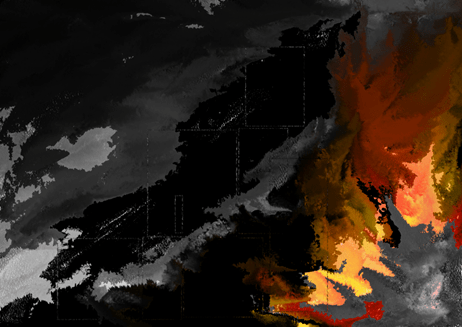
An image of fire in darkness
As Pentecost dawns the central image is of tongues of flame. But wait a minute.
To many people fire equates with fear, can be a trigger to post traumatic stress. Think Grenfell Tower, or the plethora of images of recent times of war torn, tumbled towns and cities or ravaged countryside.
How can we use this image of power and destruction for good? As part of our Christian celebration?
Think for a moment of giant redwood trees, apparently decimated by annual infernos. Witness the regrowth which follows – enlivened, fresh new growth, impossible without this devastation.
‘Deep within the trees are stored sugars from photosynthesis. They can use it for growth or metabolism … or they can store it for later. They have these really old, 50-to-100-year old carbon reserves that have accumulated for many decades that they can draw upon to build new leaves and do new photosynthesis.’[1]
Hold that image for a moment.
The prophet Joel looked forward to a time when God’s spirit would be poured out on all people. The expectation was a universal one. It was rooted in the understanding that at creation God’s Spirit moved over the face of the waters, that it had always been present. Joel sought to open people’s minds to this.
And now, at this time of Pentecost, we reflect on dispirited disciples being anointed in such a way that it seemed that flames came down among them, not of destruction, but of renewal, releasing possibilities deep within them which had been dormant, ever-present, and believe it, this same Spirit is within us.
And what was the new growth? A realisation that God’s Spirit was not exclusive, but inclusive as Joel had anticipated, would be poured out through them for all creation.
But all this is metaphor, pictures to open our minds. Our painting moves from darkness to fire and light. And, at best that illuminates the truth of the sacred worth of all humanity, and all creation. Yet to realise this our selfish inclinations must be destroyed to be replaced by the seeds of love such as we see in the person of Jesus which, if we have eyes to see, is there before us in every living person,
God, open our eyes to see with your eyes of love, warm us with the fire of your love, until we love one another as you have always loved us. Amen.
There is an argument which says that if you write hymns for the church they should be freely available. In principle I have no problem with that at all. But…
All of my hymns are in copyright. So why?
The main reason for copyright is to prevent others altering what you write? Say you have a hymn of praise to Jesus. How would you feel if it was altered to praise to Satan? – with your name attached…
Alteration can be major or minor. At the very least you can ask people not to alter your text without permission, or publish, or use your writing, or music, in contexts of which you would not approve, or want to be associated with.
You may, over time, alter your words and not want previous versions to be used. Again, you have control.
Levels of copyright
Your copyright can say ‘may be used freely’ or ‘used freely with permission’.
It can say ‘may be used freely in particular contexts’ – eg., church – but that wider or commercial use requires permission.
A few authors rely on royalties for their living. Copyright and fees become intrinsic. Even then items may be free in certain settings. All of my texts are copyright but I certainly don’t make a living from writing. Many of my texts have been used by, or commissioned by, charities. You can choose whether particular use is allowed or requires a charge.
Even when a charge is taken you can decide whether a royalty is then donated by you to charity.
Today many hymns that are in copyright are licenced for church or education use through Christin Copyright Licencing (CCL) or other licensing bodies.
Types of copyright
Personal copyright. You set the wording. You administer anything to do with he copyright. You retain all benefits in the copyright. On your death benefits would usually revert to your Executor, or whomsoever you designate in your will.
Copyright held by another. In this instance, with a reputable company, you will be consulted on use of the item that diverges from anything you have agreed with the administrator/owner. You will have a legal contract defining your rights and expectations together with those of the owner.
The benefits here may seem minimal, but can sometimes be substantial. I have a large number of hymns. My copyright holder deals with requests for use, changes of wording (in consultation with me), legal questions (rare, but could include allegations of accidental plagiarism for example), receiving royalites when texts, or music, are used and paying royalties to me, less an agreed proportion which is theirs. The copyright holder is responsible for safe retention of my material. In addition my copyright holder has promoted and published my hymns in ways that I never could have done on my own. On my death my hymns remain available and secure.
 hymnsandbooks