Lament: When anger is our highest creed

Our news invariably seems to have images of war. For those who grieve, on whatever ‘side’, Psalm 137 may give them, or us, voice.  It is often missing from our worship. Some may remember ‘By the rivers of Babylon’ by Boney M. Halfway through the song they change to Psalm 19: ‘May he words of my mouth and the meditation of my heart be pleasing in your sight…’. Perhaps Psalm 137 is seen as too violent, not Christian. But when we have suffered at the hands of others, when we grieve, lament is legitimate. Then it is understandable to use Psalm 137 in its entirety. And so I want to sing in solidarity with people in places of war and degradation…these words were inspired by the spirit of that Psalm.

1	When anger is our highest creed,
	revenge the motivating force;
	God, understand our depth of hurt,
	our need for action, not just thought.

2	Ejected from what makes us safe,
	familiar ground and well-known names,
	we sicken for the things we've seen,
	all sense of hope and courage drains.

3	We cannot celebrate our faith,
	and faith lacks meaning, all is lost;
	for nothing is as it once was,
	we cannot ever bear the cost.

4	So, God, what should we do or say?
	What is there left of love or life?
	What mitigating cause or plea
	will rid us of this pain of strife?

5	Amid our sense of grief and loss
	where nothing now can be the same,
	stand in the midst of shattered faith;
	rebuild, renew, and raise again.

Andrew E Pratt (born 1948)
© 2001 Stainer & Bell Ltd
Words ©  2001  Stainer & Bell Ltd, London, England copyright@stainer.co.uk. Please include any reproduction for local church use on your CCL Licence returns. All wider and any commercial use requires prior application to Stainer & Bell Ltd.

Metre: LM
Tune: PLAISTOW
Tag: renewal
Reflection for 2025 – Pentecost
Reflection for June 2025 – Pentecost – Andrew Pratt – originally written for the Mid- Cheshire Circuit
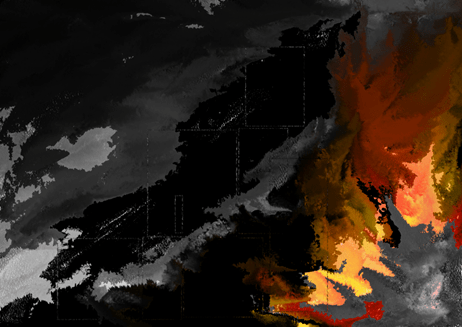
An image of fire in darkness
As Pentecost dawns the central image is of tongues of flame. But wait a minute.
To many people fire equates with fear, can be a trigger to post traumatic stress. Think Grenfell Tower, or the plethora of images of recent times of war torn, tumbled towns and cities or ravaged countryside.
How can we use this image of power and destruction for good? As part of our Christian celebration?
Think for a moment of giant redwood trees, apparently decimated by annual infernos. Witness the regrowth which follows – enlivened, fresh new growth, impossible without this devastation.
‘Deep within the trees are stored sugars from photosynthesis. They can use it for growth or metabolism … or they can store it for later. They have these really old, 50-to-100-year old carbon reserves that have accumulated for many decades that they can draw upon to build new leaves and do new photosynthesis.’[1]
Hold that image for a moment.
The prophet Joel looked forward to a time when God’s spirit would be poured out on all people. The expectation was a universal one. It was rooted in the understanding that at creation God’s Spirit moved over the face of the waters, that it had always been present. Joel sought to open people’s minds to this.
And now, at this time of Pentecost, we reflect on dispirited disciples being anointed in such a way that it seemed that flames came down among them, not of destruction, but of renewal, releasing possibilities deep within them which had been dormant, ever-present, and believe it, this same Spirit is within us.
And what was the new growth? A realisation that God’s Spirit was not exclusive, but inclusive as Joel had anticipated, would be poured out through them for all creation.
But all this is metaphor, pictures to open our minds. Our painting moves from darkness to fire and light. And, at best that illuminates the truth of the sacred worth of all humanity, and all creation. Yet to realise this our selfish inclinations must be destroyed to be replaced by the seeds of love such as we see in the person of Jesus which, if we have eyes to see, is there before us in every living person,
God, open our eyes to see with your eyes of love, warm us with the fire of your love, until we love one another as you have always loved us. Amen.
[1] https://www.science.org/content/article/ancient-redwoods-recover-fire-sprouting-1000-year-old-buds (accessed 28/5/2025)
Image © Andrew Pratt 2025
A hymn in a shattering, divided world…perhaps?
Reflecting on the world in which we live, what can we, should we sing?
Hymns should at least allow for the expression of everything to which the Psalms give voice. And I am including those words over which we tend to be rather squeamish. This interpretation of Psalm 137 was attributed to John Donne but was probably written by Francis Davison (circa 1633-69):
        Happy, who, thy tender barnes

		From the armes

	Of their wailing mothers tearing,

	'Gainst the walls shall dash their bones,

		Ruthless stones

	With their braines and blood besmearing.
[Donne, J., The Poems of John Donne, Edit. H.J.C. Grierson, Oxford 1912, p426].
And why should I want to sing this or anything even distantly emotionally related to it? Because sometimes that is how I feel and the Psalms testify to the fact that God can cope with us feeling like that.
Not finding such a hymn in my own denomination’s hymn book at the turn of the millennium, and reflecting on the plight of refugees, I wrote these words. And are they, perhaps, redolent of those of opposing opinions, experiencing hatred and fear, in our world, in our countries today?
1	When anger is our highest creed,

	revenge the motivating force;

	God, understand our depth of hurt,

	our need for action, not just thought.


2	Ejected from what makes us safe,

	familiar ground and well-known names,

	we sicken for the things we've seen,

	all sense of hope and courage drains.


3	We cannot celebrate our faith,

	and faith lacks meaning, all is lost;

	for nothing is as it once was,

	we cannot ever bear the cost.


4	So, God, what should we do or say?

	What is there left of love or life?

	What mitigating cause or plea

	will rid us of this pain of strife?


5	Amid our sense of grief and loss

	where nothing now can be the same,

	stand in the midst of shattered faith;

	rebuild, renew, and raise again.


Andrew E Pratt (born 1948)

Words © 2001 Stainer & Bell Ltd, London, England copyright@stainer.co.uk . Please include any reproduction for local church use on your CCL Licence returns. All wider and any commercial use requires prior application to Stainer & Bell Ltd.

Metre: LM

Tunes: PLAISTOW; KEDRON(Dare)
EASTER SUNDAY – Newly rigged our boat is sailing
Click the link – EASTER TRILOGY 3.1
Also see – https://www.artserve.org.uk/
 hymnsandbooks