Experience the captivating story of a violin and its players.
Harvey’s blog – regular postings can be seen here
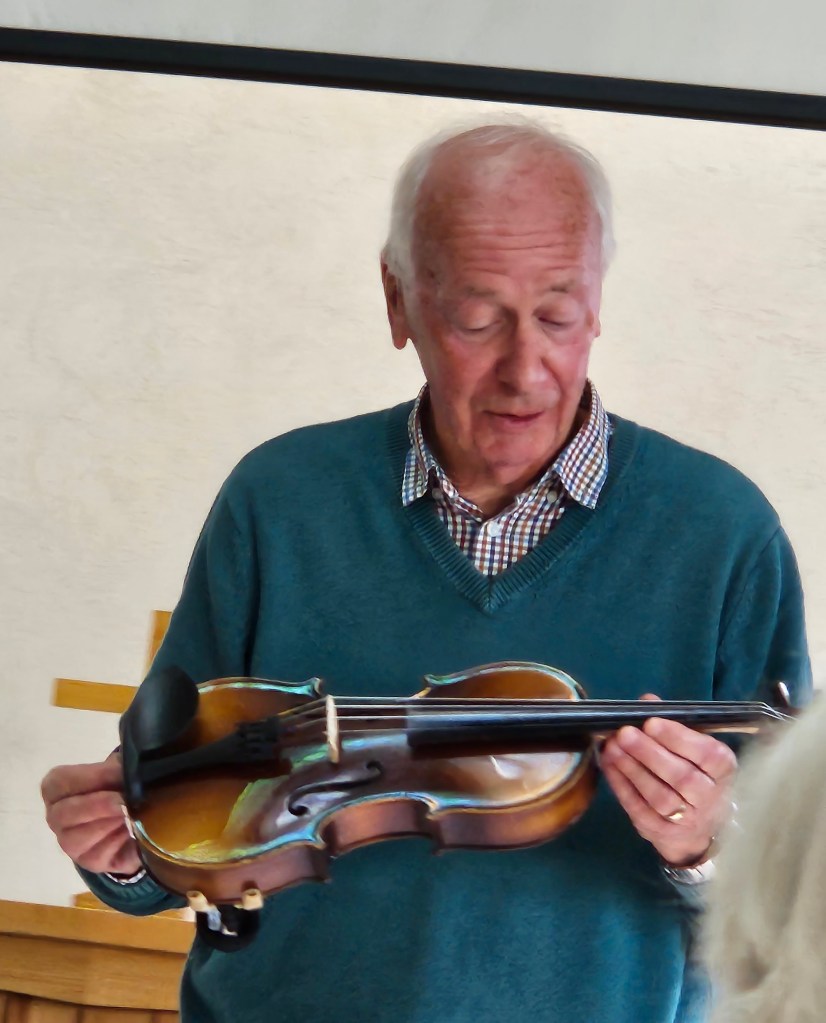
Harvey tells us the story of his violin
Experience the captivating story of a violin and its players.
Harvey’s blog – regular postings can be seen here
Harvey tells us the story of his violin
I was sitting in a fellowship group some years ago. We took turns at leading it. On one occasion a member of the group chose some music. I’d not heard it before – Saint Saens 3rd Symphony, the Organ Symphony. I closed my eyes and found myself transported by the music to, what I can only describe as, a spiritual plane. In my mind I was somewhere other than the simple room in which we were sitting. And for me, this was worship.
At the centre of worship is the expectation of meeting with God, that which is other than ourselves. It is incomprehensible that such a meeting should leave us untouched. Years later I used this same music with images of nebulae from the Hubble Telescope to imagine and reflect on creation. My intention was to engender something transcendent and, for me, that is the essence of worship. Every act of worship should be predicated on that possibility, the expectation, of just such an encounter.
But what music should I choose? Just what music is sacred?
On another occasion, in another place, I wanted to introduce the topic of spirituality in music. As the group were assembling I played a piece by Giacinto FrancescoMaria Scelsi. He was Italian and best known for composing music based around only one pitch as in his Quattro pezzi su una nota sola (‘Four Pieces on a single note’, 1959, you can find it on YouTube). To me it seemed discordant. A person walked in and simply exclaimed, ’what beautiful music’! Not all music has the effect that you expect!
I was asked on one occasion which Rolling Stones’ track could be used for someone’s father’s funeral. My response, partly facetiously, was ‘anything but Sympathy for the Devil’. They had asked because the music of the Stones linked them immutably with ‘Dad’. For them, for this moment, it was right, appropriate, religious to my mind. But we are conservative and held captive to tradition.
A few weeks ago the person leading worship in our local Methodist Church chose to use: Richard Bewes, hymn based on Psalm 46[1] ‘God is our strength and refuge’. This is set to THE DAMBUSTERS’ MARCH. For many the tune will make us think of Lancaster Bombers breaking dams with bouncing bombs in the Ruhr in the Second World War. For some that precludes the use of this tune.
But should it? Just what music is sacred? Albert Blackwell in The Sacred in Music[2]suggests that no music is inherently religious, or secular. Our feelings in relation to music come, not from the music itself, but from the things which we associate with it, images linked to it, the occasion when we heard it, the words sung to it. So the music of a hymn, as much as the words, can produce feelings which are positive or negative.
It appears that, for the most part, the editors of the Methodist Hymn Book (1933) were conservative rather than innovative. Following the Great War there was a great need to regain the equilibrium that had been lost. There is comfort to be found in those things that are familiar and safe. Edwardian and Victorian music predominated, rather than the contemporary music of the 1930s. While that is understandable it is also a block to progress in the field of hymnody, textually and musically. Anyone who has tried to use Erik Routely’s ABINGDON to ‘And can it be’, for which it was written, rather than SAGINA, which is too triumphant for the meditative open lines, will have felt that resistance.
Past experience and present context will enable one person to gain a sense of the ‘other’ from music that will leave a different person cold. What works for one may be intensely unhelpful for another. Different learning styles, traditions and expectations frame our ability to participate, or prevent such participation. How often do we take this into account when we lead, or curate worship, when we choose music? Perhaps we should think on that when we select our hymns, or the music, recorded or otherwise, used in worship. And even silent prayer is, perhaps sometimes better left silent, than accompanied by music which may bring to mind unhelpful associations, or which may jar; veiling that religious atmosphere which it is our task to engender.
Is it sometimes right that we simply hear God’s still, small voice?
Rev Dr Andrew Pratt – originally published in the Methodist Recorder for ArtServe
[1] Richard Bewes (1934-2019) based on Psalm 46m © Jubilate Hymns
[2] Blackwell, A., The Sacred in Music (1999) Lutterworth Press.
This brief essay began its formation when preparing a lecture delivered to Unitarians at Harris Manchester College, Oxford. It has bee recently published on Theology Everywhere blog
I looked out on the sunset. The sky, deep red, but fading, could not be captured by a camera’s lens, held for eternity. I mused. Different wavelengths of light refracted by the atmosphere, received by a retina, passing through a tangle of neurones, conducted by chemical and physiological interactions, perceived by something we might label consciousness. And is this all? Later I played with water colours, fluid, wet on wet, running into one another out of control, unpredictable. This was nearer to what I believed I saw. But this did not explain or make sense of it. And a realisation rose rather than forced itself on me of something ‘other’. Call that conversion if you will. It was a glimpse of the ‘other’, I will go on calling it that for want of anything better, that changed the direction of my life. Marcus Borg spoke of the light that glances into our lives rendering significance which, he felt, was something of the shared experience of the mystics. And it began an exploration that could never be complete, a pilgrimage that could never achieve its destination. I was seeking understanding of experience, trying to make sense of all that life opened up to me of joy and elation, of pain and sorrow, of love and anger, of all that is. This would encompass all of existence, birth and death and all that lay between, but also beyond, before and after. This was immanence and yet transcendence. If anything this was love.
The problem, the danger of such exploration, is that we categorise and constrain. We seek to fit into boxes an understanding greater than our human capacity can grasp. We organise it, then call it faith. And when it breaks the bounds we have set for it we say that we have lost it. Really all that has happened is that we have discovered the truth that you cannot hold or constrain that which is boundless. Neither do we have language to express the inexpressible. Yet that is what theology is often reduced to.
My early theological training was dominated by systems in which concepts and doctrines were organised. Any challenge to that organisation was viewed as dangerous, even heresy. But you can only organise things you understand and understanding suggests power, control and knowledge. By definition a total understanding and knowledge of God is a contradiction in terms. In the book Thirteen Moons, the author, a native American, ponders:
Writing a thing down fixes it in place as surely as a rattlesnake skin stripped from the meat and stretched and tacked to a barn wall. Every bit as stationary, and every bit as false to the original thing. Flat and still and harmless. Bear recognized that all writing memorializes a momentary line of thought as if it were final.[1]
I have pondered on this. So often this is what our systems of theology have done. Poetic imagination fired the prophets to enable change, to allow the understanding of God to develop, evolve. Poetry has more freedom than prose. Hymns have so often reversed that process, pinned down our theology, closed it to speculation or changing context. Sydney Carter saw folk music as owned by the singers, generation to generation – a sort of sung liberation theology, always changing.
But I return to art. A few years ago the, then, youngest member of our family was taken to Tate Modern. She reported back on the experience, ‘It was weird!’ So called modern art isn’t always easy ‘to get’. And that’s it, I think. Theology is trying ‘to get’ what is beyond our human capacity to understand, or express. Mark Rothko painted massive, single colour panels. To many they mean nothing. Others report a profound sense of the other when they view them. If ‘the other’ is such as I have suggested, perhaps these are honest admissions and, as such offer that glimpse that mystics seek, and a representation beyond words or understanding of that which we seek.
This is not to deny the validity of theology, but to recognise that theologians need to draw on the widest possible range of disciplines. These should include, but not be limited to, scriptures, languages, art, science, poetry, philosophy, music. Even then we need the honesty to admit that any theology that we elaborate can never, ever be more than a very crude approximation of the subject we are seeking to address. The quest must be open ended, never closed down, never dogmatic.
[1] Frazier, C., Thirteen Moons, Hodder & Stoughton, 2006, p 21
Andrew Pratt 20/2/2023
One gospel (Mark) doesn’t mention the birth of Jesus. The other three relate it in different ways. This has led me to reflect on the way in which different arts attempt to give expression to the nature of God.

Poets struggle with the language,
words both mystic and absurd
fail to frame the incarnation,
giving flesh to living Word.

Art constrained by expectation
will not let the colours go,
only spreading, mixing media
emulate the Spirit’s flow.

Sculptors sometimes risk the fracture,
letting stone dictate the form,
giving rise to new creation
chance God shattering our norm.

Even music caged in bar lines
lacks the freedom to expand,
till in jazz, through improvising,
rhythms stretch to new demands.

Nothing ever fixed or final,
way beyond the human mind:
mystery and imagination…
all that we will ever find…
© Andrew Pratt Written 17/12/2022

Incarnation – Watercolour © Andrew E. Pratt
 hymnsandbooks