Hope is built in present moments – hymn inspired by Isaiah 65: 17 – 25 (now with tune)

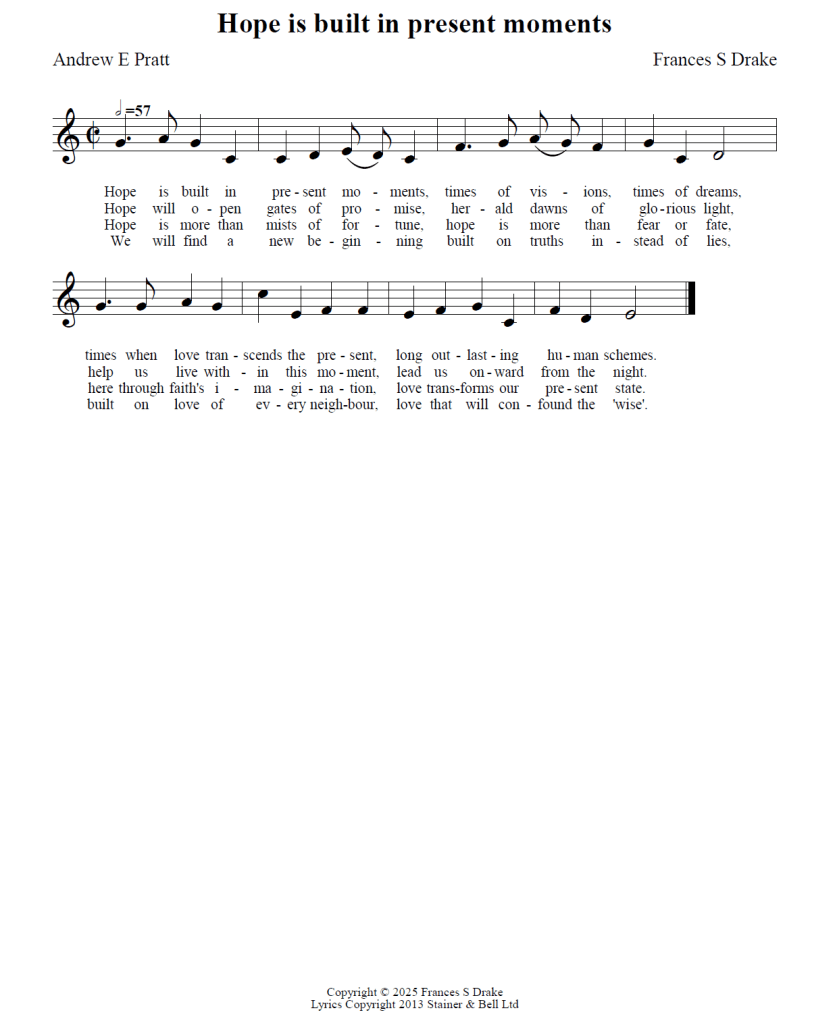
Hope is built in present moments – hymn with tune - inspired by Isaiah 65: 17 – 25 

1 Hope is built in present moments,
times of visions, times of dreams,
times when love transcends the present,
long outlasting human schemes.

2 Hope will open gates of promise,
herald dawns of glorious light,
help us live within this moment,
lead us onward from the night.

3 Hope is more than mists of fortune,
hope is more than fear or fate,
here through faith's imagination,
love transforms our present state.

4 We will find a new beginning
built on truths instead of lies,
built on love of every neighbour,
love that will confound the 'wise'.

Andrew E Pratt (born 1948)
Words © 2013 Stainer & Bell Ltd, London, England copyright@stainer.co.uk . Please include any reproduction for local church use on your CCL Licence returns. All wider and any commercial use requires prior application to Stainer & Bell Ltd
Metre: 8 7 8 7
Tunes: LAUS DEO; ST OSWALD

New tune written by Frances S. Drake reproduced with permission -

Enquiries for use of music to Hymncat@gmail.com

Lament: When anger is our highest creed

Lament: When anger is our highest creed

Our news invariably seems to have images of war. For those who grieve, on whatever ‘side’, Psalm 137 may give them, or us, voice. It is often missing from our worship. Some may remember ‘By the rivers of Babylon’ by Boney M. Halfway through the song they change to Psalm 19: ‘May he words of my mouth and the meditation of my heart be pleasing in your sight…’. Perhaps Psalm 137 is seen as too violent, not Christian. But when we have suffered at the hands of others, when we grieve, lament is legitimate. Then it is understandable to use Psalm 137 in its entirety. And so I want to sing in solidarity with people in places of war and degradation…these words were inspired by the spirit of that Psalm.

1 When anger is our highest creed,
revenge the motivating force;
God, understand our depth of hurt,
our need for action, not just thought.

2 Ejected from what makes us safe,
familiar ground and well-known names,
we sicken for the things we've seen,
all sense of hope and courage drains.

3 We cannot celebrate our faith,
and faith lacks meaning, all is lost;
for nothing is as it once was,
we cannot ever bear the cost.

4 So, God, what should we do or say?
What is there left of love or life?
What mitigating cause or plea
will rid us of this pain of strife?

5 Amid our sense of grief and loss
where nothing now can be the same,
stand in the midst of shattered faith;
rebuild, renew, and raise again.

Andrew E Pratt (born 1948)
© 2001 Stainer & Bell Ltd
Words © 2001 Stainer & Bell Ltd, London, England copyright@stainer.co.uk. Please include any reproduction for local church use on your CCL Licence returns. All wider and any commercial use requires prior application to Stainer & Bell Ltd.

Metre: LM
Tune: PLAISTOW

A Hymn for International Day of Peace – ‘Here is Peace’

 A Hymn for International Day of Peace - Here is Peace

In 1981, the United Nations General Assembly declared the third Tuesday of September as International Day of Peace. This day coincided with the opening day of the annual sessions of the General Assembly. The purpose of the day was and still remains, to strengthen the ideals of peace around the world.
Two decades after establishing this day of observance, in 2001, the assembly moved the date to be observed annually on September 21. So, beginning in 2002, September 21 marks not only a time to discuss how to promote and maintain peace among all peoples but also a 24-hour period of global ceasefire and non-violence for groups in active combat (I am grateful to Rev’d Pat Bilsborrow for drawing my attention to this day).

Hymn: Here is Peace

Here is peace, when grace astounds us
quelling all our wild pretence.
Here is peace, shalom and kindness,
passion ruled by reasoned sense.

Here is peace, when grace engenders
love that neither fades nor ends.
Here is peace when people welcome;
enemies become as friends.

Here is peace, when grace surprises
ignorance with words of hope.
Here is peace, to light our senses:
see, God’s love has boundless scope.

Words: Andrew Pratt written while listening to Mr D. Rutter, preacher, in Comberbach Methodist Church 2004; © 2010 Stainer & Bell Ltd, London, England copyright@stainer.co.uk . Please include any reproduction for local church use on your CCL Licence returns. All wider and any commercial use requires prior application to Stainer & Bell Ltd

Metre: 8.7.8.7.
Tune: ADORATION (Hunt)
A tune can be found here – Traditional Latvian Melody
A commentary on the text and tune (with an out of date biography) can be found here.


Persistent God, your gracious understanding – God’s grace at Easter

Persistent God, your gracious understanding  

1 Persistent God, your gracious understanding
returns the love that often we with-hold.
When met with our resistance and denial
you greet with peace and draw us from the cold.

2 Three times you challenged Peter's frail commitment,
that stemmed from reasoned nervousness and fear.
Three times he answered that he really loved you,
you held him though he'd seemed so insincere.

3 You see beyond our actions and our motives,
you read the hope that's written in each heart,
and in this knowledge welcome home your children
by showing each and all a place and part.

Andrew E Pratt (born 1948)
Words © 2013 © Stainer & Bell Ltd, London, England copyright@stainer.co.uk . Please include any reproduction for local church use on your CCL Licence returns. All wider and any commercial use requires prior application to Stainer & Bell Ltd.
Metre: 11 10 11 10
Tunes: HIGHWOOD; INTERCESSOR

Andrew Donaldson from Toronto, has agreed to my sharing his hymn ‘How Can We Sing, Our Souls Aghast and Shaken?’ – appropriate at this time…

Thank you to Andrew Donaldson from Toronto, a Fellow of the Hymn Society in the United States and Canada, who has agreed to my sharing his hymn 'How Can We Sing, Our Souls Aghast and Shaken?' here. It is particularly appropriate at this time, I feel.

1. How can we sing? – our souls aghast and shaken?
Sing, when our hope has broken like a bone?
Long-whispered schemes now rise up, proud and open.
Tyrants and kings, tyrants and kings
Now rule us from a throne.

2. How can we sing? What good will come with praises?
Songs fill the air; they soar, then soon are gone.
Hordes overturn our safe and sacred places,
Leave not a trace, leave not a trace,
Nor stone upon a stone.

3. How can we sing? – for who will hear our voices?
Why does a lie sound wiser than a psalm?
Shrewd powers lead from crisis into crisis;
None care to hear, none care to hear
Your shepherd’s voice of calm.

4. How can we sing, yet how can we stand silent?
Long-silent tongues have sung us to this day:
Saints voiced a hope both holy and defiant.
Breathe through our song, breathe through our song,
O Holy One, we pray.

Words: Andrew Donaldson
© 2025 GIA Publications, Inc. # U01906T
Please include any reproduction for local church use on your Copyright Licence returns. All wider and any commercial use requires prior application to GIA Publications, Inc.

Andrew suggests the following tune COMMENT VOULOIR QU’UNE PERSONNE CHANTE
French Troubadour melody
https://www.youtube.com/watch?v=ifxGjuldIko
Andrew also notes that the words fit to GENEVAN 12, but only if you don't repeat the phrase in the fourth line of text.