Listen to safe in the shadow of the Lord… most beautiful
Category: Writing
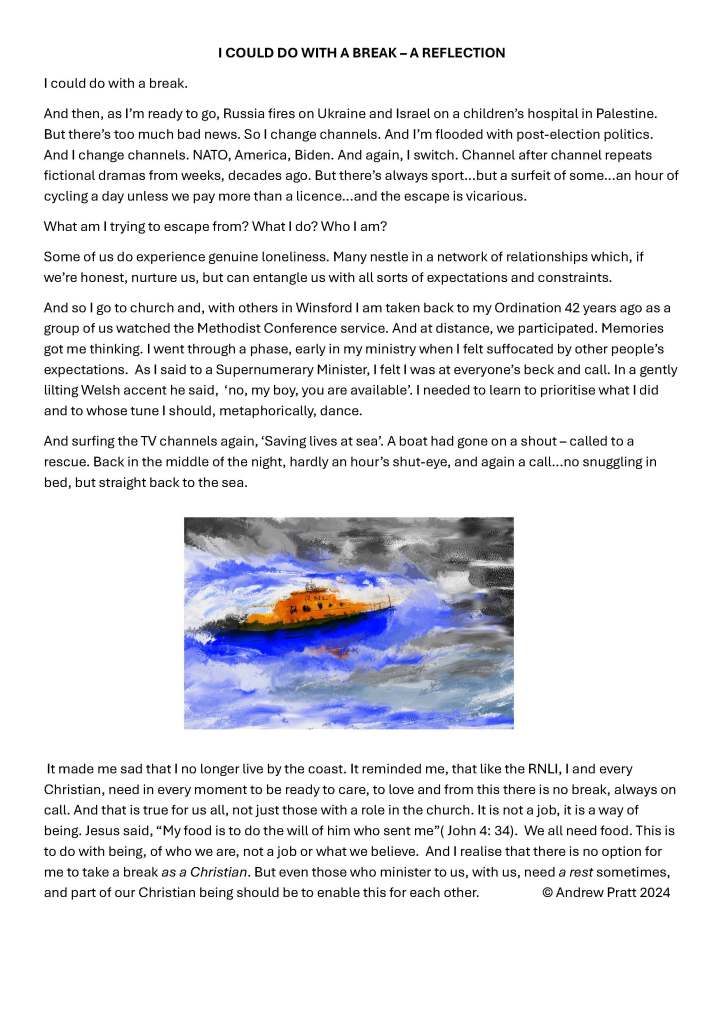
I could do with a break – a reflection…
Google RNLI ANNIVERSARY
Toward Ascension
The 9th May, 2024 is Ascension Day. That takes my memory back to school days going to, what would now be seen as, a very old-fashioned boys grammar school. On this day we were marched in the morning to a local church for a service. Other than having a morning off from lessons, I remember little of this and grasped nothing of its significance. It makes me wonder what we make of this today, if anything.
Easter was early this year. Then it was over. What then? Actually, in terms of the church calendar, it’s not over until Ascension. So what do we do in these weeks?
Over recent Sundays we have been recounting stories of resurrection. Outside the world moves toward the next commercial opportunity for retailers and hospitality. As to Ascension, what’s that? Good question.
Let’s take it literally from the point of view of the disciples. They had witnessed crucifixion. Then Jesus was back with them. Forgiveness was given, peace proffered. Back to normal. Remember when the lockdown of Covid was lifted. Back to normal, yes. But I’ve recently had another vaccination. Not all is ‘normal’. We have adjusted. I think the disciples experienced a similar rhythm. Jesus death left them orphaned. But Jesus was back. Then this ascension took him away again – ‘Handed over to orphaned, comforted, now comfort less…lost, bereft, as now he leaves them, homeless, friendless, scarred, unblessed’…as a hymn puts it. The gospel according to Matthew says, ‘and some doubted’.
Once beyond this moment what was the new normal for them? Perhaps it can teach us something. Firstly, they had to recognise that Jesus really was dead, not there. Gradually the way beyond this realisation was that the old normal was not coming back. They had to think and act for themselves. This was not just trusting for life after death, but for living life before death.
Without the Ascension they would never have reached this point. Realising this they needed a real new normal. This involved repentance for real. A total and complete change of mind. Following Covid the so called ‘new normal’ drifted back to business as usual. If we have grasped the intention of Ascension there are choices to be made, a new mindset to be adopted and a new life to be lived for real, no drifting back. That new life, for the disciples, began to express the very spirit of Jesus.
So this time coming up to Ascension what are we going to do? A time for reflection? What real new normal do we need to embody that we, you and I, might see Christ in others and they might see Christ in us – that same Spirit of Jesus?

Buzzard; Copyright Andrew Pratt 2024
What can we sing in a distorted world? – Written for ArtServe and originally published in the Methodist Recorder (March 2024)
What can we sing in a distorted world?
Language and music are taut and strained. How can we compress into a phrase a modern pieta, or a father cradling body parts?
What can we sing?
We stand in the rubble of a distorted world where dust never settles, light filters through, flickering, faulted. Shadows lengthen.
Creation is cloaked by human action, or indifference.
And, again, what can we sing?
Perhaps we should be silent?
It has been said that there can be no poetry after Auschwitz. And we turn up on Sunday morning to offer praise and thanksgiving or, expecting a still, small voice, a gentle stroll beside still waters. Have we forgotten? Perhaps. Or are we too young? Since October the seventh our slumbering memories have been re-awakened. And what do we sing? At times like these I wonder at the inability of our Christian churches to lament. Its absence in these times should shock.
I turn to two Psalms, one communal; one individual.
Psalm 137
By the rivers of Babylon—
there we sat down and there we wept
when we remembered Zion.
The nearest we get to these words, a reprise of Boney M singing ‘By the rivers of Babylon’. Notice they never use verses 8 and 9:
Happy shall they be who pay you back
what you have done to us!
Happy shall they be who take your little ones
and dash them against the rock!
Like a hybrid car shifting gear they move to something more comfortable: May the words of my lips and the meditation of my heart…’ They want something deemed ‘acceptable’.
Think of the horror of war, images that can’t be broadcast for what they portray. What would we feel? Might we not want vengeance? This Psalm says that such emotions are legitimate, human. How can we admit this in our churches? We need to know that we are still held by God when we have witnessed acts of deepest hatred and want to hit back, to wreak havoc.
But a warning. The Psalmist grasps this yet it can never be a justification for repeating the horror, simplistically, ‘because the Bible tells us so’. An ‘eye for an eye, a tooth for a tooth’ should be consigned to the past.
Psalm 22
‘My God, my God, why have you forsaken me’.
This is personal, now. The cry we hear from the cross, from the lips of Jesus, words of a Psalm uttered in desperation in the throes of death: words just for Good Friday? They are strong enough for a hymn writer to pen: ‘the Father turns His face away’. And sometimes it feels like that. Yet God does not turn away, will not leave us in distress. Nevertheless, we may still feel the reality of personal desolation. If the Psalmist felt this emotion, and Jesus expressed it, then it is common to humanity and not to be condemned. It is cry of wretchedness though not a matter of doubt, rather of supreme faith. That is the foundation lament, a certainty of the presence of God with us in spite of all, even in persecution or impending death. We only complain when our expectations are not met – a train is late, food has gone mouldy, a friend lets us down. In faith we have expectations of God, God with us, always, in every circumstance or situation. Yet sometimes we feel desolate, abandoned, as though God has gone away. And then we too can lament, we can groan from the depths of our being. And at such times we utter the deepest, most sincere prayer we may ever voice, ‘God help me!’ This is no blasphemy, but a heartfelt, visceral cry of need undergirded by a subconscious sense that when all else is absent, there is a name on whom we can call.
So what music, what language, can we borrow, can we use? Perhaps Gorecki’s Third Symphony? Or a hymn like this? – ‘When loneliness oppresses me’ from Hymns of Hope and Healing/Unravelling the Mysteries sung, maybe, to KINGSFOLD?
1	When loneliness oppresses me;
	when darkness fills my soul;
	when grief and weeping overwhelm
	and none can make me whole;
	in angry fear I call to you.
	When will you hear my cry?
	This heavy burden on my heart
	must lift, or else I die.

2	When close companions melt away,
	afflictions have no end,
	I cry for help to empty air,
	darkness my only friend.
	O God, why have you left me here?
	When will my troubles cease?
	If you refuse to hear my prayer,
	how will I find release?

Hymn - Marjorie Dobson
© Copyright 2012 Stainer & Bell Ltd, London, www.stainer.co.uk. Used by permission. All rights reserved.
A REFLECTION AS ADVENT BEGINS
Some churches, on the Sunday before Advent, celebrate the Feast of Christ the King. It offers a high spot before we descend into the darkness as we prepare for the coming of the Light of the World at Christmas. The more I think about this, the more strange it seems.
Once the Kingship of Christ made sense. I loved to sing ‘Majesty, worship His majesty’. Now it seems a bit out of kilter with what we read about Jesus. Let me reflect for a moment.
We read that 2000 or so years ago bureaucracy uprooted people. Foreign troops occupied a country. Native politicians and religious leaders juggled their own privileges and prejudices with advancement and preferment. And common people became pawns to be taxed, manipulated according their economic value to the ruling class. People counted, and needed to be counted.
Times don’t change it seems.
If we take the story literally Mary and Joseph were subjects of a census.
Set aside for a moment the Magi and shepherds, the angels and the star. ‘Long way from your home’, a baby was born. Within a short time, days? More likely a year or two, that baby was threatened as babies have been, and have been killed, in our own time, in our so called civilised world. Politics demand that difficult decisions have to be made.
Difficult decisions: so often a euphemism for oppression, diminution or judicial killing.
Majesty? A child threatened with death in the arms of his parents seeking asylum in another country. Not Majesty as we would recognise it, not a life-style choice.
If we believe that this child was God born among us, this is no majestic king, victorious, but a vulnerable baby trusted to parents fleeing persecution and death. And it challenges me to see Christ this Christmas, not in the palaces of the powerful but, more likely in the vulnerable and persecuted.
Remember that this baby grew up to be a man. Entrusted to those young vulnerable parents he was later to say ‘the son of man has nowhere to lay his head’. He understood poverty and homelessness. Then when he says, ‘whatever you did for the least of these, you do it for me’, he knew what it was like to be least in society. No wonder, in the title of an Anglican report some years ago he had a ‘Bias to the Poor’; not to ‘Lord’ it over one another.
Our God trusted human parents to care for him, and lived out an example for humanity to follow his example of trust, reliance and care in relationship to each other. ‘Love one another’.
So as we move toward Christmas let us hold onto something of the reality of the Biblical story, a story that is is awe-inspiring. This is much more than a time for children dressing up and playing games. More a wake-up call for us all, to realise that whenever we visit the prisoner, welcome the stranger, feed the hungry, provide water for the thirsty we again meet Christ, see God in those we greet… It is a wake-up call, a reminder that we find God-head, not in the powerful or majestic, not in the robes and honours of politics or religion, not in places of domination or repression, but in vulnerability and love. Truly within us and among us.
May God in Christ bless us all.
Andrew Pratt (originally written for the Mid-Cheshire Circuit of the Methodist Church 27/11/2023)

 hymnsandbooks