Toward Pentecost – when a world calls out for healing - Christ's body has been broken
1 Christ's body has been broken,
not bread but human lives,
each family has scattered,
just memory survives;
the parents cry in anguish,
the children cry in fear,
we label them as migrant,
not wanted over here.
2 These are our human neighbours,
relations from our birth,
each sister, child or brother,
as one on this wide earth.
If we claim God as parent,
'our Father' as we say,
when will we own the the meaning
of empty words we pray?
3 God, help us welcome others,
God break the barriers down,
that tears may turn to laughter,
and smiles displace each frown;
then may we live together,
forgiven by your grace,
the Pentecostal promise,
one Godly human race!
Andrew E Pratt (born 1948)
Words © 2018 Stainer & Bell Ltd, London, England copyright@stainer.co.uk . Please include any reproduction for local church use on your CCL Licence returns. All wider and any commercial use requires prior application to Stainer & Bell Ltd
Metre: 7 6 7 6 D
Tune: AURELIA
Category: Uncategorized
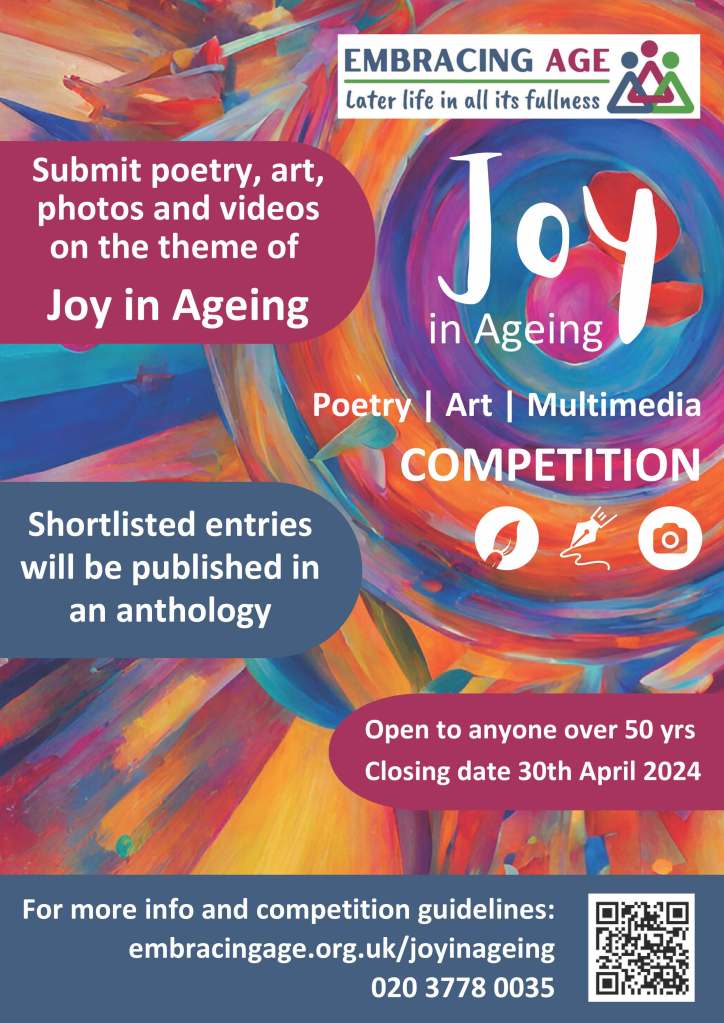
Embracing Age – Poetry Competition
Still a short time left to enter this competition –
Earth day hymn
Earth Day is an annual event on April 22 to demonstrate support for environmental protection. First held on April 22, 1970, it now includes a wide range of events coordinated globally by Earthday.org including 1 billion people in more than 193 countries.
The following hymn, previously blogged, was written in response to a Seminar given by Dr Michael Morecroft, Principal Climate Scientist, Natural England
Called to be partners with God in creation,
stewards of the biosphere, what can we do?
How can we work with the land as it’s changing,
working more flexibly, alter our view.
Here with a climate that’s moving, evolving,
summers are drier, but winters more wet,
storm, drought and flood, matched with wildfire, erosion,
raising the question how great is our debt?
Help us to learn how to live with each species,
neighbours to share with our planetary store.
Earth has a cycle, a sensitive balance,
ours to care fairly, destroy or restore.
God infuse learning, respect for creation,
give us humility, channel your grace;
all earth’s resources are precious, yet finite,
help us to value all life in this place.
Andrew Pratt 12/5/2021
Words © 2021 Stainer & Bell Ltd, London, England copyright@stainer.co.uk . Please include any reproduction for local church use on your CCL Licence returns. All wider and any commercial use requires prior application to Stainer & Bell Ltd
Metre: 11.10.11.10
Tune: STEWARDSHIP(Ruddle); EPIPHANY HYMN; SPEAN
Good Friday reflection
Reflection
This event is almost inconceivable for me. You see, I do not believe in a vindictive God who sacrifices his Son. I do trust, through faith, in the incarnation – God being human. Hands that flung stars into space to cruel nails surrendered. A baby in a manger, ‘the Word made flesh’. But if this is our starting point then it is God who hung on a cross on that first ‘good Friday’. I cannot cope with some vast plan of salvation that requires this carnage. What I can understand is a God of love, from whose love we can never be separated (Romans 8, 38)
So where does that leave us? For me Jesus embodies God’s love in totality. Ultimate, complete and utter love has to be totally selfless and this is what I see in Jesus. It is the sort of love that challenges all hypocrisy, injustice and indignity to which we are exposed and which we still experience. But there is a problem here. The moment we start to love those whom others do not, or cannot, love we become a threat to them. We either have to acknowledge that love and ally ourselves with it, ignore it, or oppose it. We are inherently selfish. Humanly we seek our own preservation. That is a biological imperative. So when Jesus challenged the powers, those around him by challenging their economy – the overturning of the tables of the money-changers, the emphasis on the importance of the widow’s tiny monetary gift, pausing to heal a woman, deemed unclean, who pressed on him in the crowd, when he had been called to heal the daughter of a leader of the synagogue – in all these ways it felt as if he was a threat to the culture and religion, the very economy of the people. This threat was to their very being. And how they behaved was no different from how we, in similar situations, behave. They behaved, literally, naturally.
And Jesus response was the only possible response of complete and utter, unconditional, all-inclusive love: that is forgiveness – ‘forgive them for they (literally) know not what they do’!
And the cross becomes wondrous, not as some great theological bargain, or the culmination of a cosmic plan of sacrifice, but in the revelation of the nature of total love that we are called to emulate.
And the world is shrouded in darkness, inevitably for in darkness we cannot see, if God is dead this really is the end. And this is why theologians, then and now, you and I, seek to explain away this horror. Yet Jurgen Moltmann, some years ago in a book which still deserves to be read, The Crucified God, sees the cross to be the test of all that deserves to be called Christian, rather than the resurrection, for here we see God’s utter love and willingness to be vulnerable, as we are vulnerable, even unto death in order to be one with us. And the scandal and uniqueness is that gods are not meant to die, wondrous God, wondrous love indeed!