
Blogs
Easter Day
Easter

Rainbow Cross

Suffocating night
smothering,
obliterating
the broken bloody body
hammered hard,
staining scarlet
that cross
of rough-cut wood

and thunder crashed
the doom of death.

Then darkness fractured,
light splintered,
fragments of colour
shot out into the brilliance
of a multi-coloured Easter morning
in a green garden.

And an empty cross
rainbow-wrapped,
images the promise
of the death-defying dawn
of new hope.

Marjorie Dobson © 2019 Stainer & Bell Ltd, London, England copyright@stainer.co.uk. Please include any reproduction for local church use on your CCL Licence returns. All wider and any commercial use requires prior application to Stainer & Bell Ltd.
From Unravelling the Mysteries, Stainer & Bell Ltd., 2019.

Quite early one morning © Andrew Pratt
A strange new day

This is the day
when perfume remained unopened,
spices were no longer needed,
cloths and sponges were unused.

This is the day
when stone was no barrier,
soldiers abandoned guard duty,
grave clothes and tomb were empty.

This is the day
when the unexpected became reality,
a man asked awkward questions,
uttered unlikely proclamations.

This is the day
when bewilderment ruled,
fear was ever-present,
obedience the only option.

This is the day
when women left hurriedly,
uncertain and warily,
to tell a strange story
to an unbelieving audience,

For they did not know it,
but this is the day
when everything changed:
death was defeated,
new life was beginning,
hope overwhelming despair.

This is the day
of resurrection.

Marjorie Dobson © 2019 Stainer & Bell Ltd, London, England copyright@stainer.co.uk. Please include any reproduction for local church use on your CCL Licence returns. All wider and any commercial use requires prior application to Stainer & Bell Ltd.
From Unravelling the Mysteries, Stainer & Bell Ltd., 2019.

Come in the morning

Come in the morning.
Come see the dawning.
Come to the garden –
life has broken through.

Jesus, dead and buried.
To his grave they hurried.
Anxious women found that
life had broken through.
Chorus

Soldiers could not keep him
for they were found sleepiing
and the tomb was open –
life had broken through.
Chorus

Peter, unbelieving,
left, still full of grieving.
Nothing would convince him
life had broken through.
Chorus

Mary, greatly shaken,
thought he had been taken.
Heard his voice that told her
life had broken through.
Chorus

Where there was despairing,
grief and horror sharing,
now there is a rumour
life has broken through.
Chorus

So God’s word is spoken,
when our hearts are broken
there will come a time when
new life will break through.
Chorus

Marjorie Dobson © 2019 Stainer & Bell Ltd, London, England copyright@stainer.co.uk. Please include any reproduction for local church use on your CCL Licence returns. All wider and any commercial use requires prior application to Stainer & Bell Ltd.
From Unravelling the Mysteries, Stainer & Bell Ltd., 2019.
Metre: 6 6 6 5 and chorus 5 5 5 5
Tune: Dance to thi’ Daddy (When the boat comes in)

Mary Magdalene

My name is Mary,
common enough in my time
to need to be identified by place, or family.
Mine is such a name.
They call me the Magdalene.

People call me other names.
Some claim I was a prostitute,
perhaps because the town whose name I bear
is famous for that trade.

Others question my sanity
and ask why it was necessary for that exorcism
of troubling devils to be performed.
They probably call me mad.

The other followers, male, of course,
know me as ‘one of the women’,
useful for everyday tasks, but mainly disregarded.

So on that day -
when all hope had drained after his execution,
the future seemed bleak and empty
and even the tomb appeared to have been raided
and his body stolen –
it was hardly surprising that the men ignored me,
ran back to the city and left me to weep alone.

The voice was kind and questioning
and I sobbed my story, not expecting help.
But it came, in one word.
 ‘Mary,’
from one who spoke my name as if it mattered.

My name is Mary.
His name was and is and always will be,
Jesus.

Marjorie Dobson © 2019 Stainer & Bell Ltd, London, England copyright@stainer.co.uk. Please include any reproduction for local church use on your CCL Licence returns. All wider and any commercial use requires prior application to Stainer & Bell Ltd.
From Unravelling the Mysteries, Stainer & Bell Ltd., 2019.

Safe, locked inside that upper room

Safe, locked inside that upper room,
too scared to let the truth be known,
disciples had to see their Lord
before that truth could be their own.

And Thomas, still so full of doubt,
would not believe the tales they told
till Christ appeared, to show his wounds -
then his conviction made him bold.

Yet doubts and fears returned again.
Once more they locked themselves away
until the Holy Spirit came
on that inspiring, vital day.

The truth is now a living fact.
The love of God can never die.
So bold apostles stood their ground –
their living Lord is not a lie.

We have not seen, but we believe
and we must witness by our faith
to living truth we have received,
awakened by the Spirit’s breath.

Marjorie Dobson © 2019 Stainer & Bell Ltd, London, England copyright@stainer.co.uk. Please include any reproduction for local church use on your CCL Licence returns. All wider and any commercial use requires prior application to Stainer & Bell Ltd.
From Unravelling the Mysteries, Stainer & Bell Ltd., 2019.
Metre: LM
Tune: NIAGARA

Poem: When what we thought was mystery

When what we thought was mystery
is rooted in the common place,
and God is found in those who love,
and those we love by grace;
then we have grasped the Christmas story,
reached its heart, beheld its glory.

When scourge and cross are recognised
in images from round the earth.
When we admit complicity
and gauge compassions' dearth;
then we have grasped the Easter story,
reached its heart, and felt its glory.

When love and justice magnify
and even mercy has no end;
when hostages find liberty
and enemies are friends;
then we have grasped the Spirit's story,
reached its heart, expressed its glory.

Andrew Pratt © 2004 Stainer & Bell Ltd, London, England copyright@stainer.co.uk. Please include any reproduction for local church use on your CCL Licence returns. All wider and any commercial use requires prior application to Stainer & Bell Ltd.
Easter Eve – Saturday – Vigil
Easter Eve – Saturday

Infinite disappointment?

Infinite disappointment
for only rain comes
from grey skies
like molten lead.
And it seems
that hope is dead
until that metal,
soft,
is knife-cut
and a sheen shines out,
like light
slant through cloud
making it seem
that hope might
just
be
possible…

© Andrew Pratt 28/3/2021

Poem: On that day

On that day,
between death
and the dawn of new hope,
there was despair and dread
from those who had heard his predictions,
but discarded them
as doom-laden prophecies
not to be fulfilled in their time.

On that day,
between victory
and defeat,
there was triumph and rejoicing
from those who had plotted to kill
another dangerous, psuedo-Messiah,
and no premonition
that they could possibly be wrong.

On that day,
between the burial
and the anointing,
the women wept
because they had been prevented
from performing their ritual caring
for the body of a Son,
a Master and a Lord.,
by those who feared
that the body would be taken
and the authorities made to look like fools.

On that day,
creation held its breath
and all was still.

But, the next morning …
what a difference!

©Marjorie Dobson

How can God, condemned, be hanging?

How can God, condemned, be hanging?
False messiahs meet such ends,
and the ones then testifying,
have no need to make amends.
Educated folk were laughing,
they foresaw what was to come,
saw disciples hiding, crying,
feeling both distraught and numb.

But that early Easter morning
brought another scene to bear,
Jesus mission had not ended,
he was risen, standing there.
Still the story, more than foolish
soon gave rise to talk and doubt.
'Surely God could never suffer?'
taunting people tease and shout.

Signs and wisdom are confounded
by that stumbling block, the cross.
Things that we once saw as wisdom
now dismissed as foolish dross.
God had shown such strength in weakness.
Those who shared Christ's dying breath
now at last could claim dominion,
love defeating hate and death.

Words: Andrew E Pratt (born 1948) © 2012 Stainer & Bell Ltd, London, England copyright@stainer.co.uk . Please include any reproduction for local church use on your CCL Licence returns. All wider and any commercial use requires prior application to Stainer & Bell Ltd.
Metre: 8 7 8 7 D
Tune: CALON LAN
Good Friday to Easter
(commissioned for the Mid-Cheshire Circuit of the Methodist Church in the UK, for March 31st 2021 - Humanity into eternity or Death into Life - this is a personal reflection of the author)

Read by Andrew Pratt - click here

This week leads us up to the excitement of Easter Sunday, but to get there we need to get through Good Friday. Far from the hymn language of ‘glorious scars’ and a ‘wondrous cross’ this day is almost impossible for me. You see, I do not believe in a vindictive God who sacrifices his Son. I do trust, through faith, in the incarnation – God being human. The language we use to explain this enigma is taut, strained – a baby in a manger, ‘the Word made flesh’. But if this is our starting point then it is God who hung on a cross on that first ‘good Friday’. I cannot cope with some vast plan of salvation that requires the sacrifice of a child, even an adult child. What I can understand is a God of love, from whom we can never be separated (Romans 8, 38).

So where does that leave us? For me Jesus embodies God’s love completely.

Such love has to be totally selfless and this is what I see in Jesus. It is the sort of love that challenges all hypocrisy, injustice and indignity to which we are exposed, and which we still experience. But there is a problem here. The moment we start to love those whom others do not, or cannot, love we become a threat to them. We either have to acknowledge that love and ally ourselves with it, or ignore it, oppose it. We are inherently selfish. Humanly we seek our own preservation. That is a biological imperative. So when Jesus challenged the powers, those around him by challenging their economy, their culture it was threatening. You remember the story of Jesus turning over the tables of the money-changers? But they were only going about their normal business. Or his emphasis on the importance of the widow’s tiny gift; surely the gifts of the rich were more important? Or again, when he paused to heal a woman, whom religion said was unclean, who had touched him in the crowd. And he had been called to heal the daughter of a leader of the synagogue! His priorities seemed all wrong. In all these ways it felt as if he was a threat to the culture and religion, the very economy of the people. He was a threat to their way of life. How they behaved was no different from how we, in similar situations, behave today. They and we behave, literally, naturally.

And Jesus response was the only possible response of complete and utter, unconditional, all-inclusive love: that is forgiveness – ‘forgive them for they literally don’t know what they’re doing’! And we, for all our protestations, are so often no different.

And the cross becomes wondrous, not as some great theological bargain, or the culmination of a cosmic plan of sacrifice, but in the revelation of the nature of total love that we are called to follow. And the human response to this call to love, because of all the sacrifice it requires us to make, is at best half-hearted, at worst vicious, for here, in our neighbour ‘spurned, derided God is dying…

Tortured, beaten, scarred and tainted,
not a picture deftly painted,
more a tattered, battered being,
torn, disfigured, stark, unseeing.

Muscles twisted, strained, contorted,
body dangling, bruised, distorted.
Life blood drying, sun-baked, stinging,
hatred, bitter hatred, flinging.

Crowds insensate, tempers vented,
full of anger, discontented.
Curses scattered, insults flying,
spurned, derided, God is dying.
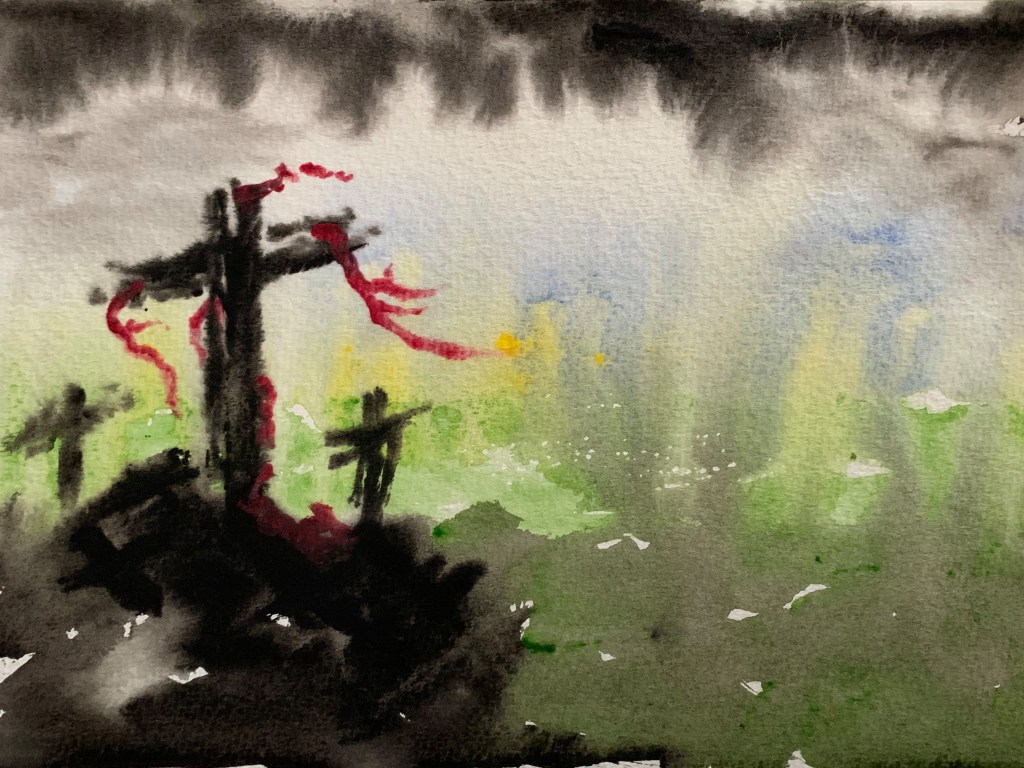
And the world is shrouded in darkness, inevitably for in darkness we cannot see. If God is dead this really is the end. And this is why theologians, then and now, you and I, seek to explain away this horror. Yet Jurgen Moltmann, some years ago in a book which still deserves to be read, The Crucified God, sees the cross as the test of all that deserves to be called Christian, rather than the resurrection. Here we see God’s utter love and willingness to be vulnerable, even unto death in order to be one with us, in order not to deny love even for those who killed him. And the scandal and uniqueness is that gods are not meant to die! Wondrous love! Wondrous God, indeed! Love divine, all loves excelling!

*********************

So where does that leave us on that wonderful dawn of Easter Sunday, when round the world people will greet the sunrise with hallelujahs? Firstly, that death is not the end! NOT THE END OF LOVE! An empty tomb was not, in the first instance, assuring. Read what Mark says: ‘Trembling and bewildered, the women went out and fled from the tomb. They said nothing to anyone, because they were afraid’ (Mark 16, 8). In another gospel Jesus, mistaken for a gardener speaks:
He asked her, “Woman, why are you crying? Who is it you are looking for?”
Thinking he was the gardener, she said, “Sir, if you have carried him away, tell me where you have put him, and I will get him.”
Jesus said to her, “Mary.” (John 20: 15-16)

Jesus continues …’Do not hold on to me...’ (John 20: 17). The language is that of leaving and, for the moment we put aside the stories of Jesus appearing to other disciples, women and men, the ongoing message is one of ‘what next’? And the answer of the gospels and Acts is not the recollection of a dead God but the continuing active living out in humanity of the sort of life that Jesus showed was possible for every human being, that risky life of utter love of neighbour of every race or creed, of those like us and unlike us so that as Brian Wren wrote, ‘there’s a Spirit in the air…when a hungry child is fed’. And yet in this past year it has taken those outside of government and the church to prompt those of power to remember that simple message. Resurrection was not a one off theological ‘thing’ but comes about every time someone Christian, or other, offers a simple gift of love. For me this reality came about after an operation when, in its aftermath, a nurse, whose name I do not know, put her hand on my shoulder saying, ‘it will pass’…and the sun streamed in the window:

Each hour marks a mighty resurrection,
a time of overcoming fate and fear,
the dawning of a common understanding
in which the grace of God is drawing near.

Each morning brings a sense of new creation.
New life, new love, encompasses the earth.
New time, new light illuminates the distance,
as though the world is coming, fresh, to birth.

Each evening brings a stunning revelation,
as stars and planets hove into our view,
beyond imagination and reflection,
these scattered bangles flung against the blue.

Each season brings a sense of co-existence,
relatedness of heartbeat, rhythm, rhyme;
and every year the cycle goes on spinning,
affirming faith and love through endless time.

Reflection, text and audio: Andrew Pratt; Poems: Andrew E Pratt © Stainer & Bell Ltd; Paintings: © Andrew Pratt from Words, Images and Imagination.
Maundy Thursday – Passover Agape / Lovefeast
Passover Agape / Lovefeast for Maundy Thursday (From the book Nothing Too Religious by Marjorie Dobson and Andrew Pratt - click to see)


Explanation: An Agape or Love Feast is a meal celebrated in some traditions which is similar to communion, but which has the potential to be more inclusive. Bread and water are used rather than bread and wine. The atmosphere is informal, more like an ordinary meal.

The order of service which follows uses this idea, but is also inspired in part by the Jewish Passover. It is based on a service for ecumenical worship which was held during Holy Week which, because of its informal nature, attracted some people from the fringe of the church, who came out of curiosity.


The following hymn or ‘Alleluia! Sing to Jesus’


This is the point of our faith for the future


This is the point of our faith for the future,

pooling our knowledge of love and of life,

bringing together the world and its people,

working for freedom, an ending of strife.


This is the God that we share, that we worship,

source of all cultures, the ground of all peace,

God in a unity dwelling within us,

growing between us and bringing release.


This is the way we will walk with each other,

walk hand in hand to the end of the way,

sharing each moment, each hope for the future,

bringing to being this dawning new day.


11.10.11.10

Tunes: EPIPHANY HYMN or IN THE BEGINNING GOD PLAYED WITH THE PLANETS

Words: Andrew E Pratt (born 1948) © 2007 Stainer & Bell Ltd, London, England copyright@stainer.co.uk . Please include any reproduction for local church use on your CCL Licence returns. All wider and any commercial use requires prior application to Stainer & Bell Ltd.


Introduction: This is the season of Passover, Pesach. Today we meet as Christians, but we remember our heritage and shared inheritance with the Jewish people. As we share this Agape, this Love Feast, this communion, it is appropriate that we identify with them and so our words are formed from our own scriptures, but also as an echo of the liturgy for the Passover. For Jews, memory is all important. In memory they are united with those who suffered and lived, loved and rejoiced before them. We echo this as we ‘do this in remembrance’ of Jesus. And so we share:


We remember tonight that long ago, on a night like this, the people with whom we share our tradition set out on a journey.

They knew enslavement and oppression, but they remembered a happier past.

God called them from slavery and offered them the courage to seek freedom.

Boldly they left Egypt, crossed the Sea, and headed into a desert. They believed that God would bring them to a far off Promised Land.

The memory of this journey they recounted and we share. It has been passed down from generation to generation. The story was told to children and to children’s children, reiterated and re-enacted from year to year.

We, too, give thanks for our freedom; we, too, imagine or remember what it means to be a slave.

And so we pray for all who are still in slavery, still denied their human rights.

As we meet at this table, we affirm that there is a place at God’s table for all people of all ages and all nations.

Here we share a cup of blessing, which speaks of deliverance, here we eat the bread of life, which speaks of freedom and unity.

May we be united with our neighbours of whatever race or creed.

May all people be free from bondage

and from oppression,

from hunger

and from want,

from hatred

and from fear;

may we all be free to think

and to speak,

to learn

and to love;

may God give us hope

and the reason to rejoice;

soon, in our days.

Amen.


This is the story that they recounted:


Exodus 12.21–27


The following hymn or ‘Sanna, sannanina’


The sacramental waiting	Hymn


The sacramental waiting

for love that is to come

is like God's constant heart beat,

the thrumming of a drum.


The things that really matter,

that keep us safe or sane,

are like God's bread that's broken,

like rainbows after rain.


The hope that holds us captive,

the grace that seals our worth,

are God's firm confirmation

that love is ours on earth.


We watch the sunbeams scatter.

The shadows flicker fast.

Yet God's love is a constant,

we know that love will last.


7.6.7.6

Tune: KNECHT

Words: Andrew E Pratt (born 1948) © 2007 Stainer & Bell Ltd, London, England copyright@stainer.co.uk . Please include any reproduction for local church use on your CCL Licence returns. All wider and any commercial use requires prior application to Stainer & Bell Ltd.


Those people continued their reflection. Whether or not this is our experience, we continue to identify with the Jews as we pray:


Our ancestors were wandering Arameans;

they went down into Egypt and lived there as aliens,

few in number.

In time they became a great nation.

The Egyptians treated them harshly and afflicted them,

by imposing hard labour on them,

they cried to God and God heard their voice and saw their oppression.

God brought them out of Egypt with a terrifying display of power,

and with signs and wonders.

He brought them to freedom and gave them a land flowing with milk and honey. (based on Deuteronomy 26.5–9)


Since then our parents in faith have been wanderers, without a home. Again and again, they have been fugitives and refugees.

Through them we share the pain of the outsider, the hopelessness of the oppressed, the distress of the homeless, the dislocation of the refugee.

They have experienced the fear that we see in those around us who come to our shores for refuge.

They were used and abused.

And now we pray to God to help us to remember our own heritage as we meet our neighbours in the strangers on our streets.

We pray for courage to trade fairly and to work for freedom.

Help us to be trustworthy and just in all our relationships and dealings with every person.

Fire our hearts with your love, that we might always strive for freedom and justice.

We make our prayer for the sake of our neighbours and in memory of all who have suffered. Amen.


The following hymn or ‘Be known to us in breaking bread’


I vow to love my neighbour, whatever race or creed


I vow to love my neighbour, whatever race or creed,

to join her in her suffering, to plead with him in need.

This love will always question, will search out right and wrong,

will give itself for justice, for those who don't belong.

This love will never falter, till every soul is free,

till nations held in bondage can sing of liberty.


Through scenes of devastation, through famine, drought and war,

we'll work in ways of gentleness, work hard till we restore

the vision of the people, the hope of human grace,

till nations dwell in peacefulness together in this place;

till all the world together can sing in joyful praise

till all have found communion together in our days.


13.13.13.13.13.13

Tune: THAXTED

Words: Andrew E Pratt (born 1948) © 2004 Stainer & Bell Ltd, London, England copyright@stainer.co.uk . Please include any reproduction for local church use on your CCL Licence returns. All wider and any commercial use requires prior application to Stainer & Bell Ltd.


And we now move to our remembrance:


Mark 14.10–25


The following hymn or ‘Author of life divine’


Bread of life and cup of blessing


Bread of life and cup of blessing,

taken in humility,

help us stand in need together,

strengthened by humanity.


Here the bread is taken, broken,

while our broken lives display

need of love from one another,

need of comfort in this day.


As the wine is poured in blessing,

common cup to pass and share;

equally, we offer gladly

patient love, attentive care.


Held by bonds that can't be broken,

strong in solidarity;

bread of life and cup of blessing,

symbolize our unity.


8.7.8.7

Tune: ALL FOR JESUS

Words: Andrew E Pratt (born 1948) © 2009 Stainer & Bell Ltd, London, England copyright@stainer.co.uk . Please include any reproduction for local church use on your CCL Licence returns. All wider and any commercial use requires prior application to Stainer & Bell Ltd.


The sharing – Bread and water are shared with people serving one another.


The following hymn or ‘Because thou hast said’


The stranger is welcomed, the enemy blessed


The stranger is welcomed, the enemy blessed,

a scandalous gospel that Jesus professed;

but can we adopt such a dangerous stance,

forgetful forgiveness, love caught in a glance?


We harbour resentment and hatred is rife;

the past shades the present and fractures each life;

we love to be certain, to cage or constrain,

the people who challenge we view with disdain.


God let us be Christ to the ones that we meet,

as willing to serve as to sit at your feet.

God give us the courage to see in each face,

the Christ who has shown how to live with your grace.


11.11.11.11

Tune: DATCHET

Words: Andrew E Pratt (born 1948) © 2009 Stainer & Bell Ltd, London, England copyright@stainer.co.uk . Please include any reproduction for local church use on your CCL Licence returns. All wider and any commercial use requires prior application to Stainer & Bell Ltd.


May God who has led his people through the ages lead us on the paths of peace out into the world to serve and to work in his name. Amen


After the blessing an ordinary informal meal may be shared while conversation continues.

